
Dance of Death – Danse Macabre

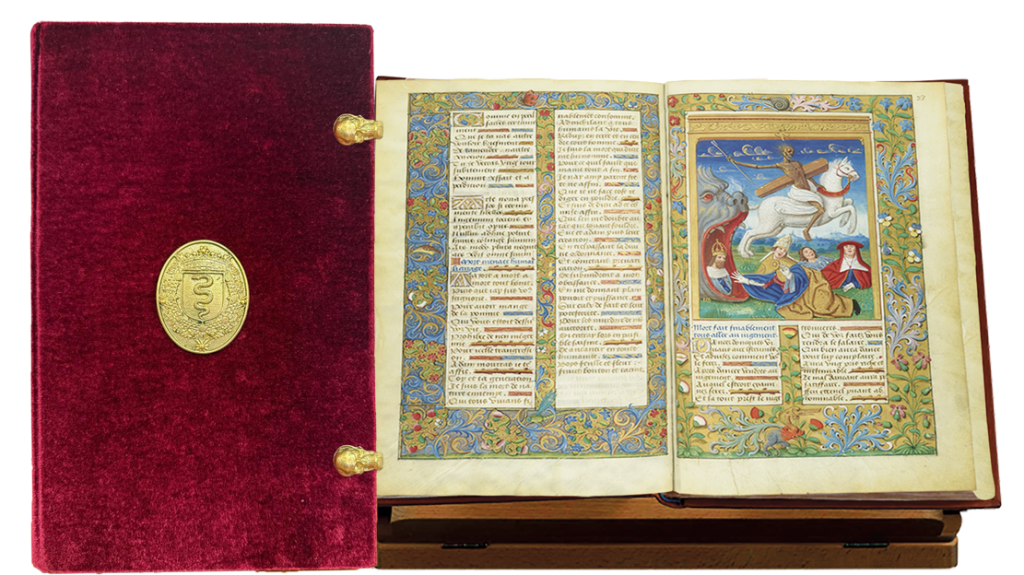
16th century. (Circa, 1570).
National Library of France, Fr. 995
Possibly the most beautifully illustrated manuscript of Danse Macabre, also called The Dance of Death
The volume has 3 parts that masterfully collect:
- The Dance of Death, properly speaking
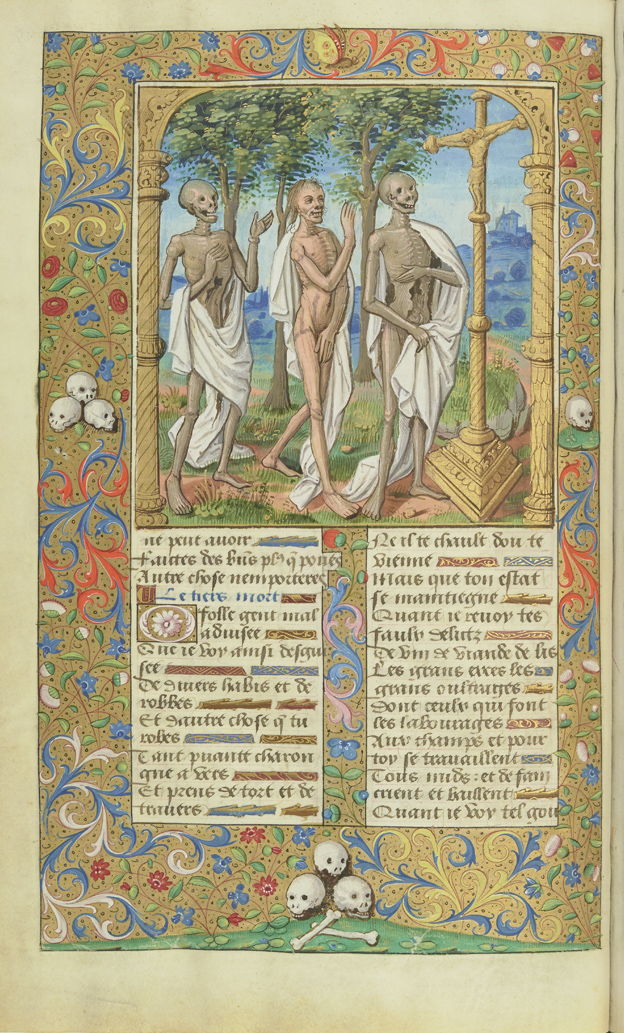
- The famous legend of the Meeting of the Three Living and the Three Dead
- And The Dance of the Death of the Women
The origin of the manuscript is unknown, but there are several miniatures by the great Master of Philippe de Gueldre, and as a whole its rich ornamentation comes from an important Parisian workshop.
104 pages of 321 x 200 mm, almost all illuminated and decorated with beautiful borders and gold
Perfect Gothic writing
Red velvet binding with gold clasps
Elegant storage case
Complementary study volume
Limited and numbered edition of 898 copies
Description of Danse Macabre (Dance of Death)
The literary-artistic genre of the Danse Macabre was widely spread in the late Middle Ages and early Renaissance, becoming a true cultural phenomenon in Europe.
Full of irony, if not a touch of mockery and sarcasm, it reminds us of the limitations of earthly life, inviting a final reflection and repentance.
The Dance of Death, an allegorical representation of enormous influence at the end of the late Middle Ages, was greatly reflected in processions with the living and the dead dancing together, to emphasize the ephemeral nature of earthly life.
It became famous, fundamentally, from the series of paintings that from 1424 adorned a wall of the Cemetery of the Innocents in Paris – in which the clergy and members of the state appeared dancing with skeletons.
But the Dance of Death enjoyed a spectacular boom at the end of the 15th century after the publication of the cycle of engravings printed by Guyot Marchant in 1485, inspired by those of the aforementioned Cemetery of Paris.
All artistic expressions echoed it, from painting – and miniatures in particular – to sculpture, music, theater, dance, etc.
According to experts: “Although during the 14th century this idea – of the Dance of Death – was promoted essentially by the mendicant orders, the universal validity of the message explains the iconographic fortune of the Dance of Death throughout the 15th and 16th centuries and its rapid expansion until it became a recurring theme in the plastic arts, sermons, poetry and theatre of the Late Middle Ages and Early Renaissance.”
Images from Danse Macabre (Dance of Death)




Contacta con nosotros
